Showing posts with label Peter Kay. Show all posts

Tuesday, May 14, 2013

Too Late to Lose Weight - Peter Kay

Though we've all grown up with the cliché "it's never too late to [whatever]," we all know that in some cases... it is. With one week to go to the Assault on Mt. Mitchell and the Assault on Marion, there is a lot of worry, stress, and even anxiety in the air.

We tend to ask ourselves, "Am I prepared?" For some reason, the vast majority will answer "Not yet."
We forget that this is not a test we can cram for. Most of us are aware of how tapering works, and most of us will taper properly. Yet - perhaps from panic - so many of us attempt to shed a few pounds before The Big Day, whether from our bodies or from our bicycles. But...

It's too late to lose weight. Don't even try. Any attempt to lose body weight in the last days leading up to these events will only have adverse effects. Kelli covered nutrition on Sunday, and it's important to read it thoroughly. Remember: all this week, maintain the body's expectations regarding eating and drinking habits.

It's like trying to save weight by not carrying water bottles. You can probably make it pretty far into the ride before needing to drink. But then you'll have to stop to drink at a rest stop... or several... and any time gains you may have made by shaving weight on the hills will be long gone.

But it's also a bad idea to try to lose weight off of your bike by using new or untested equipment. The new stuff may fail, but even if it doesn't, it can serious effect your handling and/or comfort throughout the day causing added fatigue and stress.

Avoid temptation...


This Week

  • do NOT drastically change your regular eating habits by changing what/when you eat
  • do NOT lower your caloric intake; biggest reward = bonking. If cutting out something, be sure that there's a replacement of the same/similar caloric value; for example, no alcohol this week? - drink Gatorade instead. Maintain the body's expectations.
  • carb-loading the night before the event with giant helpings of pasta, does NOT generally work. As a social event, getting to meet other riders, the traditional Pasta Dinner or pre-ride gathering is a good thing. As a preparation for the ride, it's most often unhelpful or even harmful.
An effective carbohydrate loading phase takes 3-4 days, so relying on one large bowl of pasta the night before is not going to cut it. The fact that you are tapering your training before the race automatically contributes to loading, assuming you keep eating your usual intake of carbohydrates. ... Many athletes opt for a low-fibre diet on the final day of loading, which can help prevent abdominal gas and bloating in the race. Stick with white bread/rice/pasta, and avoid eating large quantities of beans and pulses (unless you know you get on well with them), and go easy on the vegetables and salads.


  • do NOT try over-haul your bike this week; tearing it all down and rebuilding it often backfires. Yes, it is very important that you do an all points inspection, cleaning thoroughly, lubing, and making sure all the bolts are tightened adequately, etc. But a rebuild is risky and can lead to equipment failures.
  • do NOT try out new, untested equipment (or foods on event day). Now is not the time to put on new wheels, chains, cables, or even bartape. Half-way up the climb is not the time to try out some new, exotic gels. Stick to what you have and what you can stomach. (I can't tell you how many years I've seen dozens of flats in the first 2-3 miles due to participants mistakenly riding new tubes/tires in an attempt to avoid such mishaps.)
  • do NOT drastically change your riding habits. Tapering is good. Big changes take time for the body to adapt. Be smart about how much, how little, or how intensely you ride.

DO:
  • rest more; take a little extra time each day to relax - body and mind
  • plan ahead; packing your bags early and slowly using a check list
  • eat your usual breakfast the Day Of
...and remember: this is supposed to be FUN!

Peter Kay


Saturday, May 14, 2011

What to Expect : Part III

In an effort to guide everyone through the registration process and events with as few issues as possible, we've come up with an extensive blow by blow description of What to Expect this weekend.

The entire list is available for download at https://theassaults.com/What_to_Expect_2011_Assaults.pdf.


FINISH LINE
  • Once you reach the finish line, many different things will happen at once:
  1. As you cross, Clint Davis will snap your photograph.  (He will also have a backdrop set-up after the finish line for additional photo ops.)
  2. One Volunteer will ask for and remove your timing chip.
  3. Another Volunteer will hand you a patch – only one per customer, and only to the finishers!
  4. A different Volunteer will ask you “Spartanburg or Marion?” while they take your bike from you.  Tell them where you want your bike to be shipped.   All passengers ride down to Marion and unload there.  People who are taking the journey back to Spartanburg board a second bus in Marion to return to Spartanburg – their bikes however, take a direct trip from the top to Spartanburg or Marion.
(be sure to grab your computer off of your bike, and car keys out of your bag)
  • Next, you will be guided up the stairs to the front of the Gift Shop where all of the luggage will be spread out on the ground.  Once you find your own bag, use one of the SIX Changing Rooms in the parking lot (they look like extra large porta-johns) to change clothes and freshen up.Take a moment to have a warm cup of tomato soup from the Mt. Mitchell restaurant (a long standing tradition in the Assaults.)  Hang out and watch a few finishers or wait for your friends.
  • Last, board one of the passenger buses to head back down the mountain to Marion.  Expect this to take about 1.5 hours including a few brief stops to cool the brakes along the way.  (Spectators ride the same bus as the cyclists, and buses roll once they are full.)


MARION

Once in Marion, whether you are finishing there or returning from the top, you will be greeted with a healthy lunch catered by Palmetto Palate.  All participants in both rides receive one lunch, and extra meals for family, friends, and supporters are $5/person (tickets available at the Expo and on event day).
Marion is the central staging area on the day of the ride.  There will be massage therapists, showers, bathrooms, etc.  Buses will be coming in and out of the Campground all day long, and trucks will be hauling bikes down the mountain every hour or so.  There is also a large Rest Stop for the cyclists continuing to the top.  With all of this activity, we ask that you keep your children in view and your pets on leashes at all times.

BUSES & SPECTATORS
  • Once the first riders pass through, the spectator buses will begin to fill up.  These carry family and friends directly to the top of Mt. Mitchell and avoid (as much as possible) driving on the same roads as the riders.
  • Once the first riders finish at the top, they will begin to board buses that carry them down the mountain back to Marion.  Spectators ride the same buses as the cyclists, and each bus leaves the top once it is full.
  • Buses heading to Spartanburg from Marion begin to fill at about 1:00 PM and make the trip accordingly.  They will run all day and as needed.  Tickets will be for sale at the Expo and on the day of the event.
TRUCKS & BIKE PICKUP

  • There are 2 kinds of trucks that bring bikes back down the mountain.  The first only goes as far as Marion whereas the second goes directly to Spartanburg.  Remember to tell the people at the finish line where you want your bike to go!
  • In Marion, the bikes will be unloaded immediately from each truck and placed in a fenced off area.  To retrieve your bike, go to the person with the clipboard and show them your bib #.  You must have your bib # in hand to get your bike back!
  • In Spartanburg, the bikes will be kept in the lower level of the Memorial Auditorium under police supervision (in the same place as was packet pickup).
In both Marion and Spartanburg, space & time are limited, so we ask that you get your bike ASAP


TUESDAY MAY 17, 2011
  • Finish times and results will be posted @ https://theAssaults.com
  • Lost and found will be open, please contact us directly with questions regarding missing items
WEDNESDAY, MAY 18
  • 6:00 PM: Ride of Silence. Leaving from the Memorial Auditorium, this short course is a good recovery ride as well as a great cause.
THURSDAY, MAY 19

Thursday, May 12, 2011

What to Expect : Part II

In an effort to guide everyone through the registration process and events with as few issues as possible, we've come up with an extensive blow by blow description of What to Expect this weekend.
The entire pdf will be available for download via the main site shortly.
 

MONDAY, MAY 16 : The Main Events!

  • 5:30 AM : Final packet pick-up and registration for Marion opens at the Memorial Auditorium.  We highly recommend picking up your Mitchell packet at the Expo the day before (in case of any registration issues), however, we understand that travel etc may make this impossible.
  • 6:00 AM : Roads will be closed surrounding the Memorial Auditorium, so please give yourself plenty of time to find a parking space and get to the starting line.
    • Parking is available at the St. John’s St. Parking garage (upper levels only), at the Marriott parking garage (lower levels), as well as limited space behind the Memorial Auditorium.
    • Parking is NOT available in the lot across the street from the auditorium, at the Second Presbyterian Church, or anywhere on Wofford’s Campus.
    • 6:20 AM : Riders will be lining up for the start in front of the Memorial Auditorium.  Please note the 3 Signs indicating where you should line up.  The fastest riders will be at the front, most riders will be in the middle, and the slower riders need to be in the back.  If this is your first time doing Mitchell, you will most likely fall into the latter two categories. 
      • Flag Set #1 
      • This is reserved for the FASTEST riders. You should only consider riding with this group if you are planning to finish AoMM in 6:15 or less OR Marion in 3:30 or less. This means you have trained for the ride for months and you have a very high level of fitness (and most likely, you have done one or both of these events before). If you have not trained for the event and choose to start here you placing yourself and those around you at great risk of injury and/or failure. Please DO NOT start here unless you are a very skilled, trained cyclist with proper equipment and preparation.  These are the top 10% of finishers, and it is DANGEROUS to illegitimately place yourself in this elite group.
      • Flag Set #2 
      • These are the serious Weekend Warrior riders. You should consider riding with this group if you have trained well, know how to ride in a peloton, are fast and fit, but not a "racer" - realistically, you know you will not be with the lead pack riding into Marion. To be certain that you have an enjoyable experience, it is best to consider your placement and preparation carefully. 
      • Flag Set #3 
      • The majority of riders should line up behind this flag: those who are out for the experience and the joy of the event; those who did not train as much as you might have liked; those who are not racing the clock; and those whose main goal is to finish.  Ask the people around you what their pace will be, and place yourself accordingly.  Remember, we must all consider the safety and enjoyment of those around us as well as our own interests!

    •     6:30 AM : MASS START              Both the Assault on Mt. Mitchell and the Assault on Marion will roll out at the same time and cover the first 74 miles together.  After the Marion riders finish at the Tom Johnson Camping Center, Mitchell riders will continue the last 28 miles alone, plodding their way to the top of the mountain.
      • For details of the course, please read Paul's previous posts on our Training Blog and the Strava.com Event Page.
      • For driving directions to the Tom Johnson Camping Center, please visit our home page. 
      • Spectator Bus Tickets will be for sale on the day of the event in Marion for  $5/ea, and buses will begin as soon as the first group passes through.
       
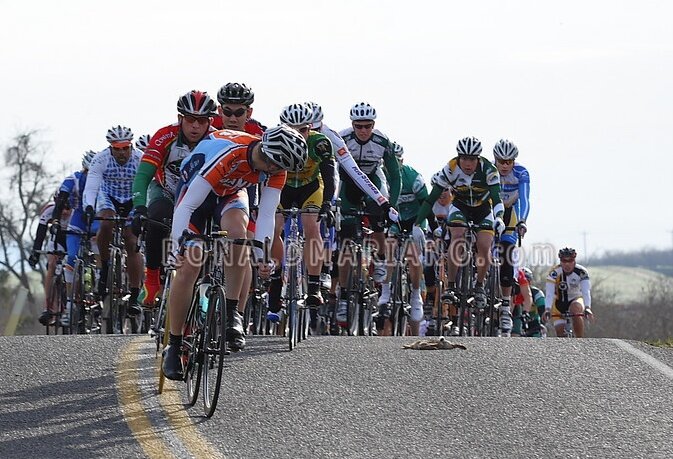
      The first few miles will be some of the most challenging – both mentally and physically.  Cyclists jostle through the pack, trying to find the right place to sit in and enjoy the ride.  The leaders will push the pace, stringing out the peloton.  Several flat tires and ejected water bottles will cause alarming and dangerous changes in the pack.  This is the most difficult time to tell yourself to be calm and find your own pace.  The heat of the moment causes most riders to push themselves beyond their comfort zones, which can ultimately ruin the ride - by either burning themselves out, or causing a crash.  When someone "blew up" in front of him last year, a close friend of mine was taken down in a crash, suffering a broken collarbone.  His ride was over after only 4 miles!  Keep your head on your shoulders and your line straight & true.
    CAUTION:  While rolling out of Spartanburg, there are a few bridges to cross.  The seams in the pavement at these points can abruptly change the peloton’s pacing, or surprise riders into overreacting.  Similarly, there are a holes and cracks in the road shortly after crossing the I-85 bridge (while on Hwy 9) that can sneak up on cyclists if proper communication is not passed through the pack.
    These bumps and seams will eject water bottles and disrupt the flow.  This poses serious hazards to everyone.  PLEASE exercise caution, maintain your line and pace, and COMMUNICATE problems that arise. 

    • 7:20 AM : REST STOP #1 @ mile marker 22; the first cyclists will begin to pass by this rest stop manned by First Baptist of Spartanburg.  The leaders will most likely not stop, but some more casual riders will pause and refill water and snacks. 
    • 8:10 AM : REST STOP #2 @ mile marker 42; the lead pack will reach the second water stop  sponsored by Walgreens (on behalf of the School for the Deaf and Blind).  The pack will have split into several smaller groups after the hills on Pea Ridge.
    CAUTION:  Just after passing Rest Stop #2, riders are greeted with a long, seemingly straight downhill.  At the very bottom of this hill is a sharp, hairpin curve that has ended many a cyclist’s morning ride.  The newly “paved” section is now more treacherous than ever with loose stone and rough edges.  We will have it clearly marked, but DO NOT come down this hill at high speeds.  DO NOT pass other, intelligently cautious riders.  DO NOT use this brief respite to try to get back to the peloton – there is a long flat stretch ahead for you to make that catch.
    • 8:30 AM : REST STOP #3 @ mile marker 47 – the summit of Bills Mountain; the front group will come by this rest stop sponsored by our friends at Mobile Meals.
      • Many SAGs will meet their riders at this important spot, and it is recommended that family/friends/support  driving the SAG course get here before 8:15 to avoid delays (getting behind the pack)
      • Similarly, it is best that they drive down the mountain toward Hwy 64 (against the flow of the course) in order to get back onto the SAG route.  From there, SAGs can leap-frog the peloton to Marion and avoid getting stuck behind a pack of cyclists.
    • 9:10 AM : REST STOP #4 @ mile marker 64; riders will begin to make this right turn onto ,this rest stop is Sponsored by SunTrust Bank, and we are exceedingly grateful for their support again this year! 
    • 9:40 AM : REST STOP #5 @ Tom Johnson Camping Center in Marion, NC.  The head of the peloton will roll through Marion after only 3-3.5 hours on the bike.  This will be the elite riders, and it is incredible to see the speeds at which these athletes will cover the first 74 miles!

    FOR MORE INFORMATION ABOUT WHAT GOES ON IN MARION, SEE TOMORROW'S POST

    • 10:10 AM : REST STOP #6 @ mile marker 85; halfway up the Hwy 80, volunteers from Bethel United Methodist will share encouragement and ice-cold drinks with those struggling to beat the 8-10% grades 
    • 10:20 AM : REST STOP #7 @ mile marker 87; the leaders will begin to enter the Blue Ridge Parkway at this junction.  Manned with porta-johns, tech support, and lots of fluids and food, the Spartanburg Humane Society help riders fuel up for the long, steady climb ahead. 
    NOTE: The cut-off time to reach this point and to gain access to the Blue Ridge Parkway is 3:00 PM. One must average 10.25 mph over the course of the day in order to make it here in time.

    • 10:40 AM : REST STOP #8 @ mile marker 93; the elite group will pass the approximate midpoint on the Blue Ridge Parkway, with friends from the Running Club lending support at this rest area. 
    • 11:00 AM : REST STOP #9 @ mile marker 98; the leaders should be entering the final leg of the journey .  Placed at the last turn of the day (onto the Mt. Mitchell Parkway) this stop will be manned by volunteers from the Oak Brook Preparatory School. 
    • 11:20 AM : REST STOP #10 @ mile marker 100; the first riders to enter the State Park will pass the last rest stop, also manned by the Oak Brook Prep volunteers.  With the home stretch ahead, cyclists will have a brief respite, a temporary plateau, before the final kilometer grind to the top! 
    • 11:30 AM : FINISH LINE; we expect the first finishers in roughly 5 hours, though if conditions are good, we may also see a new course record!
    STAY TUNED FOR MORE INFO ABOUT EVENT DAY AND POST RIDE....   

    Peter Kay
    Assaults Director
    https://theAssaults.com

    Wednesday, May 11, 2011

    What to Expect : Part I

    In an effort to guide everyone through the registration process and events with as few issues as possible, we've come up with an extensive blow by blow description of What to Expect this weekend.
    The entire pdf will be available for download via the main site shortly.


    SATURDAY, MAY 14 : Spartanburg will be a host of activity two days before the main events take place.

    • 9:00 AM : SPACE has partnered with the Assaults this year to offer the Cottonwood 5K Trail Run/Walk at Spartanburg High School (registration opens at 8:15am).  You don’t have to be an Assaults participant to join in, making this a perfect event for friends and family members coming into town to support their rider! FREE EVENT
    • 3:30 PM : The Assaults will be showing a remixed and remastered version of the documentary of the 1988 Assault on Mt. Mitchell in our first annual Afternoon Film.  Seating is limited. Complimentary tickets are available on our website.  Come enjoy the history and the popcorn.  This is good (nostalgic) fun for everyone! FREE EVENT
    • 7:00 PM : Globalbike presents the Assaults Vélo Social.  This is our first annual cocktail party and mixer, and we hope that everyone can join us that night.  Rahsaan Bahati and Robin Farina will be there, mingling with the crowd, so come out and take advantage of this opportunity to hang out with the pros!  Plus, we will be serving RJ Rockers beer, Carriage House wines, and Palmetto Palate hors d’oeuvres. $15/person 

    SUNDAY, MAY 15 : Getting ready for the big day ahead, we will have the Expo, packet pick-up, and the Assault on Morgan Square.

    • 2:00 PM : Partners for Active Living has teamed up with the Assaults to offer our first ever Assault on Morgan Square, a kid’s ride with all ages welcome.  The event will take place downtown on Main St. between S. Daniel Morgan Ave and Spring St.  Budding athletes will “climb” the hill from the Herald Journal to the clock tower and “descend” back to the start.  Prizes & Giveaways, helmets required. FREE EVENT
    • 1:00 – 8:00 PM : Packet Pick-up at the Spartanburg Memorial Auditorium.  Here, registered riders can pick up their goodie bags filled with information and merchandise.What to Expect: Upon entering the room, you will see rows of tables labels such as “Mitchell (A-E)”, “Marion (F-M), Timing Chips, etc.  Begin by going to your event table that is labeled with the first letter of your last name.  There a kind volunteer will ask for your bib number, and then they will ask you to show your photo ID and sign & date a release waiver. 
    • After you have gotten your packet, please double check to make certain that you have everything you ordered (extra t-shirts, armskins, bus tickets, whatever).  If you are a Mitchell rider, you will then proceed to the Timing Chip table where you will show your bib number and be assigned a chip. 
    NOTE:  The timing chips are very expensive, and if you lose yours or fail to return it, your results will not be posted and you will be billed a $150 replacement fee. 
    • Additional BUS TICKETS and MEAL TICKETS will be for sale as well.  If you need a Sunday bus ticket (if you are planning to leave your car in Marion and need a lift back to Spartanburg), please note that the bus leaves Tom Johnson Camping Center at 4:00 sharp.  You will need to purchase your tickets by 2:15 in order to make the drive to Marion in time to catch that bus. 
    NOTE: If you purchased a ticket online or during registration but can’t make it to the Expo before 2:15, there will be someone at the Camping Center with a list of people who have purchased Sunday Bus Tickets.  Simply give them your name and get checked off of the list.  
    • DRY CLOTHES BAGS: Outside the Expo, there will be TWO trucks – one will carry dry clothes bags to Marion and the other to the very top of Mt. Mitchell.  Be sure to label your bag using the luggage tag in your packet (with the same number as your bib).  This will help us to identify it after you finish, or in the case that you do not finish, we will be able to get the bag back to you more quickly.
      • MOST IMPORTANT:  Pack all of your clothing into a trash bag (or water proof bag) which you then place inside your luggage bag.  In case of rain, we will do our best to keep the bags dry, but wind and sudden onset makes this job a very difficult one.  
      • Bring both warm and cool weather clothing.  It is simply impossible to know what conditions will be like at the top (or even in Marion). Don’t forget to bring shoes, and a towel is highly recommended.  
      • Many people pack a small amount of money - there is a concession stand at the top that serves hot chocolate, coke, and coffee (among other things).  As ever, we will have the traditional tomato soup freely available to all finishers.
      •  Bringing a plastic baggy with some hand wipes is also recommended.  It’s a long ride down to Marion, and you may want to freshen up before boarding the bus.  
      • Please DO NOT pack car keys or a wallet in your Mitchell bag.  If you need your keys after the ride, either put them in your saddle bag and carry them with you for the whole ride (making sure to get them out before shipping your bike back to Marion) or pack a second bag that is shipped to Marion.  Otherwise, you run the risk of being stranded if you cannot complete the event.
    • 1:00 – 8:00 PM : Once you have your packet and timing chip in hand, you will enter the Expo.  Here you can peruse the many different cycling specific booths from Quarq to Powerback to Boyd Cycling.  Several bike shops will be there, too, so you can pick up any odds and ends that you might have forgotten or may think you’ll need (nutrition/hydration goods, gloves, glasses, spare tubes, whatever!).

      Palmetto Bank will be raffling off Assaults accessories like armskins, slipstreams, and base layers.  Robin Farina will also be hanging out at the Uptown Cycles booth, and John DeLong will be hanging out at the Quarq booth.  Outside, Trek will have several demo bikes ready for anyone to ride.  It’s going to be an exciting afternoon! 
    •  
    NOTE:  we will not be having a Pasta Dinner as in years past.  Far too many cyclists have specific routines and dietary desires, and interest in the dinner has been waning.  In lieu of the Pasta Dinner however, we are hosting the Vélo Social on Saturday night (see above) in an effort to continue the tradition of bringing participants and the community together before the ride. 

    STAY TUNED FOR MORE INFO ABOUT EVENT DAY....   

    Peter Kay
    Assaults Director
    https://theAssaults.com

    Thursday, May 5, 2011

    The Taper

    What does it mean to "taper?"

    It's crunch time and a lot of us are feeling the pressure of the deadline.  The Assaults are 10 days away, and many are beginning to question their training.

    The worst thing any cyclist can do right now is "cram."  There is simply NO way to make-up what you haven't already accomplished this spring.  The next 10 days should be "review," and recovery - not trying to get in those last few hills and mountains or trying to lose those last few pounds.

    From here on out... you work with what you have!

    ========
    Before any event that a cyclist takes seriously, there should be a period in which volume tapers off so that the body can rest, recover, and rebuild broken-down muscle tissue.  Each person is different, so there is no one way to taper.  That said, there are certainly a few generalizations that can be made:

    1.  Most cyclists do best with a 7-10 day Taper.  Some people need less time, but almost no one needs more than 10 days (after that, one begins to lose a bit of fitness).

    2.  Taper refers to "tapering off" which does NOT mean stopping altogether.  Similarly, the first few days of the taper should only be moderately easier than usual (or shorter) while the last few days of the taper may feel too easy or short.

    3.  Decrease volume more than intensity.  Short rides with a few hard blasts will keep your body's metabolism going, the blood flowing, and your muscles used to stress.  You want to keep the engine revved up without burning much fuel.  At the same time, try to avoid breaking down the muscle fibers too much.  Don't go out and do serious hill reps for an hour - but throwing in a few hills OR a few sprints during a casual spin will help keep the legs loose.

    4.  By the end, one should feel almost twitchy with excitement and energy - NOT sluggish, lethargic, or "soft."  These are signs that an athlete didn't taper correctly.  If you feel yourself getting tired a few days before the ride - get outside and pedal around a while.  It won't hurt you to change your taper along the way (so long as you don't burn up your legs).

    5. In the last two days, it is generally considered best to take Saturday completely off the bike, ride a short and easy ride on Sunday (45-75 minutes at a recovery pace with no real hard efforts).  This is a perfect combination of rest and active recovery that primes the pumps for Monday's hardest efforts.

    If needed (schedule conflicts, etc), you can also swap these two days, riding easy on Saturday and resting on Sunday, although your legs will most likely take far longer to "wake up" on the day of the event.
    ========
    Many are headed to the mountains this Saturday, and that's okay.  So long as it's a shorter ride - less volume - and slightly easier than usual (no need to take risks, bombing the descents... there's no clock and there's no prize!).

    As I said earlier, a taper could be as many as 10 days, but for some it's far fewer.  The length of time isn't based on age or experience - although, that does play some roll in the process.  Instead, it's more about genetics and lifestyle.  A 35 year old, Cat 2 racer with an active and stressful job may actually need longer than a retired man who simply cycles as a hobby.  Trial and error is still the best way to find what works for you but within the framework of the guidelines above.

    The key is to rest, eat well, and stay hydrated.

    -Peter Kay
    http://TotalCyclist.com

    Tom Johnson Campground/Marion, pt. 5

    May 5: "Tom Johnson Campground"/ Marion

    About 74 miles in, riders either finish at Tom Johnson Campground or transition into the climbing sections of the Assault on Mt. Mitchell. The campground is key because of the added traffic and the likelihood that many cyclists choose to stop here for more food and water/drinks--often meeting a SAG or family member. Everyone should be careful about stopping, letting other riders know your intentions, and watching for spectators stepping into or across the road. For me, as a side note, I tend to make this my psychological transition--from Spartanburg to Marion, I am a pack cyclists; from Marion to the top, I ride alone (or pretend I am alone) in order to maintain the pace I want/need and avoid being lured into climbing too hard at an early stage and flaming out before the end. From Marion to the top is nearly 30 miles of riding, most of which is climbing. Riding smart from Marion to the top is important.

    Paul Thomas, EdD, Associate Professor
    Furman University

    Friday, April 29, 2011

    With Great Power Comes Great Responsibility

    Uncle Ben was right when he said that (...even if he wasn't the first).

    This could be viewed as mechanical power - that which needs a power meter to see - and yeah, that's true in a lot of ways, too (as I will discuss below).  In truth however, we understand Ben to be saying that a person of great strength of character, leadership, and influence has an obligation to illustrate proper and safe behaviors while upholding his or her duties to the betterment of the group as a whole.


    I am reminded of a few training rides we have done in the past year in which certain Pro riders have joined us.  The Upstate Winter Bike League had a number of top athletes in the ranks.  Sometimes our weekly rides pull in a few Cat 1 racers.  On occasion, I've visited other cities and joined in their group rides/events - finding strong riders at every level.  In each case, it became evident that there are higher expectations for those riders who have proven themselves in either the sport of racing, in events like the Assaults, or even just the weekly rides.
    Note:  This is not a discussion about Ride Leaders (organizers) or about individuals appointed to a leadership role.  However, those jobs are necessarily imbued with social, ethical, and moral responsibility!


    Perhaps it is easier to understand how someone earns the respect of the pack - how one goes about "proving oneself" - rather than trying to dissect the image of one who already has, and here we come to the heart of this posting:  With Great Power...

    Within the last 2 weeks, I have witnessed both the strength of character and sportsmanship that should be displayed by truly strong and powerful riders.  In those same 2 weeks, I saw he exact opposite on display as well (but I will use a ride from last Fall to illustrate the point).


    Bruce Humphies is a powerful cyclist, and he is an excellent example of a responsible athlete.  When he joins us for our Tuesday night ride, he could easily drop any one of us.  Even working together, our Average-Joe crowd probably couldn't chase Bruce down if he wanted to stay away (in fact, the whole Pro1/2 peloton couldn't bridge the gap when Bruce soloed to victory in the SC State Criterium Championships last week).  On Tuesdays Bruce sits on the front and pulls, and when we enter an "open zone" with a sprint sign at the end, he attacks - but only so hard as to make us all work.  He never leaves the group totally behind - and we all enjoy chasing!  After each zone, he waits until we're all together and ready to start the next bit.

    Similarly, when we are "neutral" in between these zones, Bruce goes back to setting pace or sitting in, observing the "rules" set out by either the Ride Leader or the tradition of the ride.  If someone has a flat or machanical, he waits with the rest of us.

    Parker Kyzer is a powerful cyclist.  Though young, he is fast becoming a top athlete in the sport, and it is clear that he understands the responsibility that comes with it.  Last week, a large group of us rode over Bills Mt and back, following the Assaults course.  Again, Parker rode on the front for much of the ride, setting a reasonable pace - and by reasonable, I mean one that allowed for everyone to participate.  It was quick, yes - but not impossible and certainly not racing speeds! 

    On the way back a few riders fell in to difficulty.  Some of us were still feeling strong - including Parker - but rather than storming off into the distance, leaving our compatriots to rot in the hot sun, we worked together to come home as a group.  But! In order to make the ride a challenge and get a good workout in... Parker pushed the other cyclists who were in trouble!  (with their permission, of course)

    In this way, he wasn't "wasting time" out there on the road.  Both Parker and Bruce do interval training before or after a group ride in which they will be the strongest or fastest guys (which, I surmise, is quite often).  OR they do their intervals on a different day.  They do not do their intervals during a group ride; a major faux pas!


    I was on a group ride last fall, and after a long, casual warm-up, the Ride Leader (Robin Farina) turned back with some of the slower cyclists.  She rode the short loop in order to make sure everyone got home safely.  Despite the fact that she is a Cat 1, Pro athlete, she rode ~35 miles at 16mph that day.

    I remained with the "fast group" on the long course, aiming for ~55 miles.  Under the "leadership" of some of the local hammer-heads, the ride quickly devolved into what Chad Andrews calls, a "DS" ride (the second word is "Swinger"... the first, I leave to your imagination).  It was fast and vicious.  At one point, there were only 2 of us left - the rest had been dropped!  Had I not asked for a regroup (and gone back myself), they may never have seen each other again.

    Of course, I enjoy racing, and I enjoy the simulation of racing.  What surprised me were the dangerous and selfish actions taken by the guys on the front.  They didn't regroup (despite it being a group training ride).  They didn't stop at traffic signals.  They didn't communicate directions or call out road debris and holes.  Pushing the limits of a group ride, splintering the group, and shattering the peloton every time you go out... is pointless and unhelpful.  Read Paul's blog "the Not-so-good Ol' Days," and my own post "Why We Are Here" for more.


    Some people view themselves as "Leaders" who should not.  Some people view themselves as strong and powerful riders, though they are not.  And in an attempt to illustrate their own self image, they behave poorly

    Riding away from a group while the group is "neutral," rolling through stop signs or traffic lights without stopping, failing to regroup at the group's behest, "attacking" (or failing to slow/wait) when others are in difficulty, have a mechanical, are avoiding a dog in the road, or are in some way hampered by road conditions, etc... these actions are unsportsmanlike and shameful.  Doing any of these neither impresses the peloton nor proves the strength of the offender.  In fact, this kind of behavior sets very bad examples and incites dangerous reactions.  Remember, often there are new riders in the pack - and everyone must set a positive examples for the newbies so that they will ride safely and, more importantly, continue to ride.

    Like lemmings in spandex, the peloton will blindly follow into self destruction, and it is the duty of those with great power to act with great responsibility!

    Please consider all of these points as you ride tomorrow, in the final weeks of Assaults preparations, and in the summer months ahead.

    (...and now for the double back-flip, Triple-Lindy, Soapbox Dismount...)

    -Peter Kay
    http://theAssaults.com
    http://TotalCyclist.com

    If you are not interested in keeping the group together, then you are not interested in riding with a group.  Don't muck-up a good ride by breaking etiquette and riding selfishly.
    Fulfill your dreams and ride solo.

    Sunday, April 3, 2011

    Set-backs

    Over the last week, I've been dealing with a few "set-backs" in my training.  We had rotten weather: dramatically varied temperatures, sporadic thunderstorms, and freezing rain, and winds that were treacherous at best.  Most of us did our best to squeeze in rides.  Whether it be during a brief sunny day or on the trainer at home - we got the time in.

    However, I was unfortunate enough to have the ol' double whammy... bad weather AND a bad cold.  Though I was able to get in a few afternoon rides here and there, I was neither able to "train" (intervals) nor get some real time on the bike.  Congested and achy, I alternated between the computer and the couch most of the week.

    On Sunday, Tuesday, and Friday I rode for about 1-1.5 hours at a casual 16.5 mph pace.  I threw in a few hills and a few brief hard efforts to test my legs on Friday.  My legs were fine.  They were good, in fact!  But my lungs and my nose couldn't keep up, and after a few seconds, I could feel my system slowing down... so I slowed down.  Unlike allergies, a cold can get worse if you try to push yourself, continuing to train.

    Let's face it, I'm not going to make a living riding the bicycle.  There's NO reason for me to press my luck, riding in 40° temps, in the rain, while sick.  There is nothing to be gained by that.  It's better to heal - take the time off, let your body do the work, hydrate, watch what you eat, and get back on the bike when it's time.

    And it will be time again.

    All too often, inexperienced athletes try to push themselves through an ailment, but rather than coming out stronger, they usually cause the sickness to last longer, inevitably wrecking months rather than weeks worth of work.  The best thing for us to do is rest.  Rest, recoup, and come back ready to start training again.


    The other issue that I see in so many athletes is the sense of "catching up."  Yes, a cold can make you miss time, but that time is gone.  You can NOT make up that time by adding extra miles or hours the following week.  In fact, immediately adding time/distance would be more detrimental that the week off!

    So how does one "come back" from a week of nearly NO riding?

    "Pacing myself, sir."
    -  There is one key thing to remember when returning from an extended time off; whether due to sickness, work, travel, family, or something else:

    You will not be as strong on your return as when you left:  endurance, anaerobic capacity, and aerobic base are all effected by this kind of long break (though each in different amounts).  Yes, you will have freshness, but you will not have the same fitness level.  So be very careful not to over-extend yourself in the first few days back.

    It's tempting to go out and try to knock-back a 14+ hour week after having been off the bike for 10 days, but this will only lead to the dreaded "Over Training" which can destroy an entire season!  (Trust me, I've been there... don't ever pound on dead legs.)

    Start slowly - 1 hour easy.  The next day add some time and a few hills, but keep conservative.  Add a little each day until, after at least a week, you are back to where you were two weeks before your time off.  Yes.  2 weeks before.  It's a set-back, but you will be riding stronger in the long run.

    Your coach can give you specifics on how to go about recovering fully, but in general, it's best to be patient.

    My biggest frustration this past weekend was missing out on the Rock Hill Races.  This has been one of my favorite races each year, and I was really bummed that I couldn't be there this year.  The funny thing is:  I was sick last year at this time, too!

    I remember saying to myself, "Hey, there's always next year," and to my surprise - there wasn't.  But will there be a 2012?

    Probably.

    So, I will just take a deep breath, slowly ramp up my training, focus on the next  big event on my "race calendar," and go from there.

    -Peter
    ==========
    http://theAssaults.com
    http://TotalCyclist.com

    Tuesday, March 22, 2011

    \ˈau̇(-ə)r\ \Vō-ˈka-byə-ˌler-ē, və-\ \'and\ \Kə-ˌmyü-nə-ˈkā-shən\

    Our Vocabulary and Communication is unique.  With a word and a point, we can warn those around us of impending disaster - a cavernous hole in the road, a wheel wrenching sandpit, or a man-eating canine on the hunt.  With two words and an arm-wave we can direct a mass of 200 people, in mid-conversation, coursing down a winding narrow road, to make a 110° turn at 25 mph.  With the flick of an elbow, we can say, "Hey man, I'm tired of fighting the wind.  I think it's your turn now.  When I move to my left, you stay straight and continue at the pace I set.  Me, I'm going to slow down and get behind someone.  Thanks!"

    Many of the terms and their definitions seem obvious to the experienced cyclists, so much so, we often take them for granted.  Below is a list of common words and phrases that we should all know and use.

    ============================
    Communication is a key element to the survival of this multi-headed buzzing beast we call the peloton.  Without it, the animal will bunch up and grow fat right in front of a passing auto.  It might explode, blowing tires, breaking frames, the fragments disintegrating over the length of the road, parts strewn about the way.  If we don't all communicate with one another, the pack cannot and will not work.  People will be left behind, truckers will veer dangerously close in anger, bumping elbows and ensuing crashes will be inevitable, and we will have no one to blame but ourselves.

    There are two very important kinds of communication in a group ride:  physical and verbal.  As I mentioned in a previous post, "What's the Point," much of what we say needs to have a gesture associated with it.  When pointing out obstacles or giving directions, it's best to accompany words with some sort of hand/arm motion.

    Still, there are some terms that cannot be accompanied by waving about.  For instance, "Car Back" is not something we need to point out.  However, it is something that everyone needs to hear!

    It is essential that we ALL take part in passing information from the front to the rear and from the rear to the front.  Note that some terms may sound the same on a windy day or in a large group.  "Gap" and "car-Back" often sound alike, but as long as riders pass the information up, it is less likely that the message will be skewed.  Similarly using two words for the latter helps to clarify whether the group needs to slow down, tighten up, or some other action.

    Above all else:  KEEP COMMUNICATION SIMPLE:  use monosyllabic words; only shout in phrases not sentences; don't give details, names, or descriptions; try to make each term have it's own, unique lilt rather than each word sounding the same.  Similarly, don't joke around.  Only shout for a reason - passing along info.  The people on the front might think there's something wrong or the people on the back might be looking for a hole, and this can (and has) lead to crashes and other disasters. 

    ============================
    Basic Terms of the Peloton Include:
    • LEFT turn : emphasis on "left;" accompanied by pointing 
    • RIGHT turn : emphasis on "right;" accompanied by pointing or right turn signal
    • Car BACK : emphasis on "back;" when a car is behind the group and wants to come around; if a small group (2-4 riders) convert from two abreast to single file; if a larger group (5+) tighten up towards the white line, 2 abreast.  PLEASE DO NOT convert to single file with a large group - this makes it more difficult for a car to come around!
    • Car 'ROUND : (sometimes just "'Round" - short for Around) when a car begins to pass on the left
    • Car UP : (often sounds like "RUP") less often used; in large groups in which the group spans from white line to yellow line, it's necessary to point out cars approaching from the front
    • Gra-VEL : (gravel) for gravel, sand, or other loose dirt; accompanied by pointing
    • DOG : self explanatory - direction can also be given ("DOG LEFT")
    • HOLE : any form of gap in the pavement; accompanied by pointing. [see Rough Road for longer sections of damaged pavement]
    • CLEAR : when approaching a stop sign or red light, shout clear when no cars are coming from either direction (variations: CLEAR LEFT - when turning right; CLEAR LEFT then CLEAR RIGHT - when crossing a large, 4+ lane road.  [see alternate, paceline usage below]
    • CHAIN :  if a chain drops, the cyclist will stall (and sometimes stop).  This often happens on a hill where the bike loses speed quickly; the rider becomes a roadblock.  Response:  the person who dropped the chain should immediately shift to the big ring to put the chain back on; even while doing that, they should use their momentum to get out of the way; DO NOT:  stop in the middle of the road; and there is no need to look down.
    • GAP : when a cyclist or group is off the back of the peloton but is trying to reconnect (not used in "A Rides" - but should be in every non-drop ride)
    • Glass : self explanatory; accompanied by pointing
    • Rough Road : accompanied by either/both pointing and direction ("Rough Road Right"); for extensive sections of cracked and broken pavement that can lead to crashes or flats.
    • Tighten Up : less often used; for any group that is more than 2 abreast or the two riders are too far apart.  Usually in conjunction with Car Back.  Response:  everyone moves closer to the white line on the edge of the road (the left-most cyclist should be approximately in the middle of the lane or closer to the white line)
    • On-y'r LEFT (or Right) : emphasis on the side on which you are passing, ("On Your Left"); for a cyclist or group of cyclists passing another, slower moving person/group at a notably faster speed.  Response: (made by the slower person/group) move in the opposite direction (if there is available space) or stay perfectly straight, allowing room for the faster people to pass.  There is no need to look over one's shoulder, the faster riders have assessed the situation!  Often, it is best to "get out of the way," so tighten up and move over. [this term is unnecessary in a paceline]
    • Mechani-CAL : for any type of bike issue that causes a person to stop; flats, dropped chain (that won't get back on), broken shifter cable, etc.
    A couple of Paceline terms that are meant only for the next person in the group (not shouted for everyone):  "Clear" and "Last."  The first is used to indicate that there is enough room for person at the front to pull into the slow lane and begin drifting to the rear.  Last is used by the last rider in the fast lane to indicate that the last person in the slow lane can move over without having to check over his/her shoulder.  We will cover paceline etiquette in another entry later.
    ===============
    Please Note:  If you are not interested in keeping the group together, then you are not interested in riding with a group.  Don't muck-up a good ride by breaking etiquette and riding selfishly.
    Fulfill your dreams and ride solo.


    -Peter
    https://theAssaults.com
    http://TotalCyclist.com

    Saturday, March 12, 2011

    Dress for Success : Preparing for Bizzare Temperature Swings

    On a day like today...

    Admittedly, two months ago I would not have called 45° cold; especially on a day with blue skies, calm winds, and a bright sun.  In fact, one particular ride not so long ago, we were joking about how relieved we were that the weather was so nice:  partly cloudy and 40°.

    Today is different.

    1.)  Acclimation (or acclimatization) is the process by which we gradually adjust to our environment.  That's why a 45° day in winter is balmy while in summer it would be down right "freezing!"  Our bodies can adjust to the weather to allow comfort, but our bodies need a good bit of time to make that adjustment.  Each person acclimates at a different pace, and the amount of change (i.e. difference between your comfort level and what you are trying to achieve) determines the amount of time a person will need to fully acclimate.

    Riding on cold weather days leading up to the Assaults means that you will handle the start well.  However, it may mean you will hit the wall in Marion, where temperatures are often in the mid-70s.

    2.) Today is much like the Assaults:  a huge swing in temperature.  A 25° shift in the air temperature is tough on the body - made worse when it's 45-70.  There is a much more significant difference between these temps, considered cold and warm, whereas a swing between 0-25° or 70-95° is less so - we dress either very warmly or strip it all off... and that's it.

    Starting out in chilly and ending in warm temperatures means we have to bundle up and peel as we go.  Our pockets will be over-flowing with warmers, vests, food, phones, etc. We may not be able to handle all the extras, so be sure to consider every article of clothing carefully.

    Starting out too cold can lead to tense muscles, wasted energy, or worse: injury.  Whether your tight muscles don't give, and you tear something or your shivering causes you to crash... it's just not safe to be "cold" at the start.  That said, being "a little chilly" is ok - in fact, it's good.  You will warm up, and you will begin to strip off layers, so it's best to save a little space by not wearing too much at the start.

    In general, you should not need to pull off layers in the first 45-75 minutes, no matter how hard you are riding or how quickly the temperatures rise.

    3.)  So what is the best way to dress for this event?  Layers.  We've all heard it, but what does it mean?  Unfortunately, it's different for everyone, but there are some general guidelines to go by.  Here is a link to a "What to Wear" chart, which is a good place to start:
    http://totalcyclist.com/home/images/stories/thumbs/PDF_Files/What_to_Wear_this_Winter.pdf

    This is a good catch phrase: "If it's below 60 degrees, cover your knees!"  That's a good starting point, but as ever, "Know thyself."  The key to success in these events - in all aspects - is to know your own limitations and needs (nutrition, hydration, clothing, climbing speed, etc).

    So, use this as a guide and then experiment. Try out different combinations to see what works best for you... and keep trying things out as the seasons change, as you buy new clothing, as you get stronger, and as you get older!  (I definitely don't dress the same as I did 5 years ago.)

    4.)  Practice changing clothes on the bike.  Practice peeling layers while rolling and stuffing them into your pockets without getting those pesky sleeves caught in your spokes!  Practice putting them back on.  Practice all of these things away from everyone else!  Whether it means you only do this stuff on your solo rides or it means you drift off the back of the group to make a quick change, don't try to "go pro" right in the middle of the pack: way too dangerous!

    4.) Disclaimer:  yeah, so the Assaults are like none other.  No one knows what the top will hold.  Some years, it has been in the 90° range at the finish, and others it has snowed (both of these are possible in the second week of May!).  We usually start around 50°, reach mid-70s in Marion, with temperatures steadily dropping as we climb skyward.

    The best way to prepare for this kind of change is to watch the weather stations carefully and make an educated guess... then pack accordingly.  A friend of mine always said, "It's better to have it and not need it, then to need it and not have it."  That holds true in a lot of ways - but use common sense, too.  Don't carry a fleece-lined, rain jacket if the forecast is 80° and sunny.

    5.)  Disposable Warmth.  If the temperatures are going to skyrocket, but are just too cold to bear at the start, I will sometimes wear "disposable" layers.  I might put a strip of plastic bag under my Armskins or Slipstreams (which are good down to ~45°, but breathe in such a way that particularly cold days can be too light).

    This is a lot like the Pros who grab a newspaper at the top of a long, cold descent.  It's meant to keep off the chill, but they will dispose of it rather quickly (without the need to put it back on).  I don't do this on most rides - but sometimes I will put that little bit of extra wind protection on just for a little while.

    Two things to remember though:  1.  Make them extra easy to remove (usually, I can just slide it off my arm while the Armskin stays in place); 2. please, please, please Dispose of them properly.  Throw them in a trash can or something like that - dropping it in the road is bad for the environment, but worse for the guy behind you who now has a plastic bag stuck in his rear derailluer!

    =======
    It's difficult to prepare for major changes in the weather, but with forethought and practice, a cyclist can be completely comfortable on game day.

    -Peter
    https://theAssaults.com
    http://TotalCyclist.com

    Tuesday, February 15, 2011

    Why We are Here

    There is a kind of intrinsic beauty in the mating of a person and machine; an elegantly simple union, resulting in a powerful and liberating experience.

    Cycling is the best sport, the best outdoor activity, the best past-time, the best... everything.  If we didn't believe that wholeheartedly, we wouldn't ride as much as we do.  It frees us from our daily grind.  It allows us to leave the office, the house, the stresses, and the worries of our lives well behind us - if only for a few hours.  We ride with our friends (whether they are with us or not), and we use that time to rebuild what the day has torn down.


    As a child, most of us still remember that key moment in our lives - that one, pivotal experience which we will never forget: riding for the first time without training wheels!  At that moment, a person feels that there are no limitations - anything is possible.  The bike becomes a symbol of freedom.

    Mind you, it is not our means of escape, but rather, it is a sanctuary itself.
    I still remember my first experience riding without training wheels... I was a late bloomer - all my friends had already learned to ride.  I don't know why it took me longer to figure it out, but it did.  It wasn't a lack of trying - and my father helped as much as possible.

    One day, while at a friend's house, I hopped up on his bike to give it another shot.  In moments, I was free - flying without anyone's assistance!  There is no way to explain what happened; why I was suddenly able to ride.  Something just clicked, and I was off... doing circles in his driveway.

    So it was a little anticlimactic.  I didn't venture far, and it was years before I rode with any kind of regularity or goals.  But a significant goal was accomplished.  I was free!  (and more importantly for a young boy, I was now a "full-fledged member of society")

    The cycling community has its cliques, its snobs, and its anti-social people.  On the whole however, it's much like a family.  We bicker, we quarrel, but in the end - we all work together to get to where we're going.  We are friends and we are "brothers in arms," suffering and working together to reach the summit or overcome whatever nature can throw at us.

    From the 1st Assault to the 35th, riders have reached the top, jumped off the bike, changed clothes, and volunteered.  They help the other finishers find clothes/food.  They help load bikes onto the trucks or direct traffic.  They help at rest stops along the course, and so on and so forth.  Just as we take pulls, we help those around us to achieve this massive undertaking because that is the nature of our sport.  (again... the best sport in the world.)
    • Though it isn't the only reason to do it, shaving our legs is a Rite of Passage - a symbol of our dedication to the sport and to the community.  Aside from the long list of practical reasons for a male cyclist to shave his legs, being recognized as a "full-fledged member of this particular society" is probably the biggest reason to do it.  It's an unspoken rule - but understood.
    A wonderful example of what cyclists do for one another can be seen in Chris Horner's actions in July of 2008 at the Cascade Classic.  With over a mile to the finish (uphill), Chris helped another cyclist - from another team - who had crashed, totaling his bike.  Rather than leave the young man to walk the final stretch (possibly missing the time-cut), Horner said, "get on," and pedaled both the cyclist and his bike to the top!  (Click Here for more pictures.)


    Cycling is a wonderful sport and creates comradery at every level.  Top Pros help each other out all the time - it's inherent to the nature of the sport: drafting, rotating pacelines, pointing out holes in the road.  This kind of community is just one of the reasons cycling is the Best Sport Ever.

    -Peter Kay
    http://theAssaults.com
    http://TotalCyclist.com


    Monday, February 7, 2011

    "Know Your Place!"

    After reading Paul's last blog entry, I'm reminded of a time I was on a group ride some years ago and heard someone shout, "know you place!"

    It was an angry sentiment - a more experienced cyclist yelling at an inexperienced rider who had just committed one of the "cardinal sins" of pack riding:  by changing lines dramatically, he had cut someone off, causing a crash in the back of the group.

    What caused the accident was fairly simple - a guy pushed himself well beyond his capabilities, and in exhaustion, he began making poor choices.  In this case, the newbie had ridden as hard as he could up the left side of the group, from the back, passing everyone in the group, in order to get a better placement in the peloton (having always heard that the best and safest place in the pack is near the front).  He had gotten about as far to the front as he could (or dared to go), and then dove sideways into the group to seek shelter from the wind.

    Unfortunately, I see this happen all the time: a guy rides up the left side of the road, passing everyone, but in doing so, he burns himself out.  By the time he actually gets to the front, he cannot hold his place there.  He burns all of his energy flying up the yellow line (or over it), jumps onto the front, and blows up.  Then everyone around is forced to work around him as he is shuffled to the rear again (if not off the back entirely).

    The result of this newbie's move years ago - diving into the group, bumping someone's front wheel as you can imagine - was like a bomb going off; cyclists swerving and veering off the road like bits of shrapnel in every direction.

    This rider had inadvertently overlapped his rear wheel with the front wheel of another rider.  But here's the thing:  that cyclist (the one whose front wheel was hit) did not go down!  He was a strong athlete with good bike handling skills and many years of experience.  He flexed his line and adjusted his speed to take the blow.

    The trouble arose farther back.

    Reactions to changes in speed are exponential:  when the First person slows a fraction, the Second must slow twice as much.  The Third must slow twice as much as the Second (thus four times as much as the First), and so on and so forth.  The person on the back is forced to slam on the brakes, then sprint to catch back up to speed.

    We call this the accordion effect (sometimes the slinky effect - same idea, but "accordion" also references sound... and in truth, this action is most like particles of air in sound waves or compression waves).  It's most obvious when slowing for a turn, but it happens on hills just as often, and it can even happen on a flat, uninterrupted road during which someone hesitates to drink from a water bottle!


    So by abruptly ducking into the group, the newbie had caused a chain reaction that ended in disaster several riders back.... but the cause was undeniable.

    Fortunately, no one was severely injured (bruises, scrapes, scratched components), but the new guy got a good tongue lashing from the stronger cyclists up front.  "Know your place," one had said, and though it was sharp and unforgiving - he brought up a good point.

    All too often, people breeze through advice columns and forget to read why.  Why do cyclists ride in the front of a group?  Who is up there and why are they up there?  What makes a peloton work and what makes it collapse?

    Just as every rider should choose (or create) a group ride based on abilities (being completely honest with oneself), every rider should also choose a place in the pack based on personal experience and comfort.

    If you are just hoping to hang on - go to the middle:  there will be fewer and smaller surges, fewer gaps, and plenty of draft.  If you are a strong, steady rider who can set pace - ride on or near the front.  If you are planning to lead the ride - please be near the front at almost all times (it's hard for the caboose to steer the train).

    The point is:  "know thyself."  Be honest with your capabilities and comforts.  Yes, you cannot grow without pushing yourself sometimes, but a group ride is not the best place to go well beyond your limits.  Consider everyone's safety first.  In truth, you will gain more by sitting in and working on pack-skills than by killing yourself, blowing up, and riding home alone.

    -Peter
    http://TotalCyclist.com
    http://theAssaults.com

    Wednesday, February 2, 2011

    Why We are Here

    Why do we do the things we do?  What is it that compels us to ride as much as we do, to create seemingly impassable goals, and to work tirelessly over many months to better ourselves?

    Sifting through hundreds of emails over the last few days, getting to know some of you through quips and comments, I began to realize how strikingly similar we all are.  Each of us has our own reasons for the journey.  Some are riding the Assaults for the first time, "just to see if they can do it."  Some are riding on behalf of a friend or a loved one who is seriously ill - or a cause like Globalbike, the Vera Bradley Foundation, or the Chem-Way Charitable Crew (as I often do).

    Some of us tackle this event for the sheer fun of it - meeting new people, enjoying the beautiful countryside, and basking in the warm sunny weather (hopefully!).  Some of us want to beat our old times - set a new Personal Record (which may have been set when we were 20 years younger!); prove to ourselves that, "We've still got it!"

    And, I'll bet some of us just ride the Assaults out of habit: Michael Davis (31 times), Richard White (21 times), Tim Sprouse (22 times), Robert Scofield (21 times), Paul Thomas (15 times)... and the list of veterans goes on and on!

    But there was a recurring theme in all of the emails I have been getting... regardless of the goal - each of us has a GOAL - this thing in front us, pushing us forward.  Preparing and training, reading and learning, reworking our schedules, making sacrifices, we all make choices based on how it will effect our achievement of  this goal:
    "I saw the brownies on the counter-top all day... but I resisted!"
    "[Have to be careful of that] second helping of tortilla soup.  Now I have to start building some serious base miles and climbing!"
    "I forced myself to ride today, even though I wasn't in the mood..."
    "Now I have to start hitting the hills!"

    It's the thing that motivates us; a "carrot on a stick," so to speak - off in the distance, but always in front of us, egging us onward.  We register now - in February - in order to commit ourselves and our free time to the long term training necessary to get to the finish.  It's a test of willpower and of inner-strength - even more than physical strength!  It's something that takes months to build up to - so it takes dedication and stubbornness.

    We prepare, we practice, and we give up those things that (deep down inside, we know) aren't good for us.  We pedal on days where the weather isn't so good, or work didn't go well, or we just don't feel like it...
    We push ourselves because that feeling of accomplishment is never disappointing.

    The countless hours on the bike add up to something, and that is why we train for the Assaults.

    Of course, this still doesn't answer the question, "Why do we ride?"  There are marathons out there; triathlons and cliffs to climb.  So why have we chosen this, the most excellent sport?

    ...to be continued...
    Although it was written for runners, I found a great deal similarities and useful information in Running: The Sacred Art, and plan to discuss that next time!
    (and yes, the forward is written by Kristin Armstrong - Lance's ex-wife).

     -Peter
    http://TotalCyclist.com
    http://theAssaults.com

    Saturday, January 29, 2011

    "Let's Roll" Ride Recap (part I)

    Today, a wonderful group of riders turned out for our first Official Assaults Training Ride!
    Click Here for the details on Strava

    Dave Proctor built a superb course that included many, many hills in the area, and the Great Escape provided excellent SAG support, rest stops, and a post-ride meal.  - all greatly appreciated!

    The Assault on Marion is a difficult ride - not just because of the hills and mountains (which don't really appear until about half-way through), but because of the speed of ride.  Once the group turns onto Parris Bridge Rd, there is almost a 30 mile stretch with no major climbs at all (rollers, yes).  The pace tends to be blisteringly fast!  Many fight to hold on, smoking their legs in the process.

    So today we started quickly, setting a quick but steady pace over rolling terrain.  This helps to simulate the Assaults experience.  Of course, we cannot simulate the ride exactly without doing the actual route - nor would we want to in January - but it was a great way for many to prepare for the events!

    Remember, at this time of year, you want to be consistent and steady - getting in those base miles and time on the bike.  A few hard rides like today are good for the system as well as good for your mind (a change of pace).  But you do NOT want to be hammering all winter long or you will be over-trained in May.

    Just like the Assaults, the beginning of today's ride was quite chilly, whereas the finish was considerably warmer.  True, the Assaults don't actually begin at 40° and end at 60°.  Still there's usually a 20 degree shift throughout the day.  Typically, the temperature at the start is a mild/cool 50-something, Marion is in the upper 70s, but the temperatures often drop back down near the top*.
    *It is important that all riders pack a bag of clothing to be shipped to the top - with warm and cold weather clothing, a towel, shoes, etc.  Also - it's a great idea to put all of your belongings in a plastic trash bag inside of the bag in case of foul weather.  More about this later though...
     So, how DO you dress for such a wild swing in temperature and weather?

    Layers.

    Think about flexibility and ease of access.  First, you will want to be able to peel off a layer (arm-warmers, knee warmers, gloves, or vest) while riding.  If you have a thick jacket or a long sleeve undershirt, it will be difficult to make small changes along the way.  It would be better to wear two pairs of arm-warmers, peeling them one at a time than to have a full coat that doesn't fit into your jersey pocket.

    Whatever you think you might wear - practice it now!  Go out and experiment with different combinations of clothing, and work on taking off your arm-warmers,  vest, leg or knee warmers, etc while moving.  This is NOT recommended on a group ride - practice while you are alone until you are steady and completely comfortable with bike handling.

    I am certain that the other bloggers will want to weigh in on the oft asked, "How do I dress for this?" question.  We will return to this topic a few more times this spring as conditions change.  But for now, practice making adjustments and fixes while moving, practicing this while riding alone.

    -Peter
    http://TotalCyclist.com
    http://theAssaults.com